
Guest Feature Article by Kiran Patel
In the lead up to this year’s Wrestlemania, WWE was going viral for all the wrong reasons.
Following the acquisition of WWE by TKO in September 2023, criticism towards WWE’s superfluous sponsorships and branding, increased number of ads (including during PLEs), and sky-rocketing ticket prices had started to mount. The build up to Wrestlemania 41 felt like the final nails were being screwed into the coffin of WWE’s ‘boom’ period, and for good reason.
For the third year in a row, Cody Rhodes, WWE’s top babyface since John Cena, had to deal with external influences screwing up his Wrestlemania storyline. In retrospect, it could be said that The Rock’s involvement at Wrestlemania 40 allowed for Cody Rhodes prevailing over Roman Reigns to feel like an even bigger moment, and that the highly-criticised involvement of Travis Scott at Wrestlemania added a chip on the shoulder of both men to deliver their acclaimed match at Summerslam that year. However, after Pat McAfee was revealed as Randy Orton’s mystery caller, on top of Jelly Roll acting as Rhode’s top confidant in the lead up to Wrestlemania, fan investment in the storyline, and the product as a whole, felt like it was at an all time low.
And then, something very interesting happened.
A week prior to the company’s flagship show, the hashtag #LivVsStephanieMainEvent started trending on social media – and for good reason. Despite receiving only a fraction of TV time that both Rhodes and Orton had received to develop their build, both Liv Morgan and Stephanie Vaquer had put their all into making it must-see. The intensity of their brawls, the quality of their promos, and the real-life tension that seemed to simmer beneath their social media exchanges only made their eventual clash at Wresltemania 41 that much more enticing. Given that the men’s WWE Championship program was being actively hijacked by TKO and all its hype flushed down the drain, it seemed only appropriate, based on fan investment and meritocracy, that the women should main event Night 1.
This wouldn’t be the first time that the women would receive the main event spot of Wrestlemania based largely on fan interest. In 2021, the hashtag #SashavsBiancaMainEvent started trending a week prior to Wrestlemania 36. Of course, it can be argued there weren’t any strong contenders for the Night 1 main event, and Bianca Belair and Sasha Banks’ storyline, while to no fault of their own, wasn’t particularly exciting. However, the interest from the fans in seeing this first-time match up, the calibar of talent involved, and the historical precedent that would be set by this match, far outweighed any other potential contender.
What solidifies the women’s case to main event even more, however, is that WWE explicitly told us that the women would main event one night of Wrestlemania 41. In fact, since the women’s Royal Rumble in 2024, WWE have announced prior to the match that each winner of the Royal Rumble will go on to main event Wrestlemania. This year was no different. The commentary team repeatedly insisted the same all the way up until it was announced that Rhodes vs Orton, neither of whom won the Royal Rumble, would officially be the main event of Night 1.
It’s not unlike WWE to formulate their own constitutions of terminology to avoid fan criticism. For example, in previous years, they’ve described the last two matches on a PLE card as a “double” or “co” main event. In most cases, this meant having the men’s match go on last, and the womens championship match go on second to last (in other words, the death slot). However, there couldn’t possibly be any confusion or misunderstanding around stating that the winner of the mens and womens Royal Rumble will go on to main event Wrestlemania; each winner will main event each night of Wrestlemania. Simple, right?
Apparently not. Since the inclusion of this “main event” introduction prior to each Royal Rumble match, no womens match has main evented Wrestlemania. In fact, the female Royal Rumble winner’s Wrestlemania storyline isn’t even given a morsel of the investment and TV time that that men’s Royal Rumble winner’s storyline receives. This year, despite all these odds stacked against them, both Vaquer and Morgan somehow managed to drum up enough anticipation that fan’s demanded for the two to be placed in the Night 1 main event over two well-established male stars. However, even this wasn’t enough to put them in the main event. It seemed clear from the beginning that WWE had no interest in pivoting from original plans, especially for a women’s storyline. So it begs two important questions: firstly, what actually constitutes being the main event of Wrestlemania? And secondly, will the women ever be in it again under the rule of Triple H and TKO?
Part 1: What Constitutes Being the Main Event of Wrestlemania?
In October 2024, at the Bad Blood post-show press conference, Triple H was asked why there was a lack of Black representation on the card. Bad Blood was the company’s third PLEs in a row not to feature any black male wrestlers. The Head of Creative’s answer was as follows:
“I don’t see the difference in anybody. I don’t see the color, I don’t see the nationality, I don’t see any of it, I just see talent […] I don’t see the difference between men and women. I see talent. We tell stories with those talents, how they can handle those stories and how they can represent those stories and how we can bring those stories forward. I don’t keep track of any of that. I do what’s relevant and what is best and the best in storytelling and what’s being delivered the best and then that’s what goes.”
Rather than owning up to the criticism of his poor booking of black wrestlers, Triple H has consistently turned to an outdated colourblind rhetoric as a way of regarding talent. In his words, it is only their wrestling ‘talent’ that he takes into booking considerations, rather than factors of their identity. However, what this argument doesn’t account for is the hidden criteria inherent in Triple H’s view of talent. With a few exceptions, like The Rock, WWE’s franchise players have historically been white, male performers. This is likely because WWE’s creative team can resonate with them more closely, based on their own life experience and WWE’s historical identification of what a “top star” entails (such as Hulk Hogan, Stone Cold and John Cena). However, when it comes to black wrestlers, the exceptionality rule stands. Unless the wrestler gets organically over with the fans in a way that is undeniable (like Oba Femi and Trick Williams, who had already built solid fanbases during their time in NXT), only then will creative use their own tools to sustain their popularity. Otherwise, in the case of performers like Carmelo Hayes, The Hurt Business, Hit Row, the Street Profits, and countless others, you’re pretty much left out to dry.
TL;DR: Triple H has a bad case of unconscious bias.
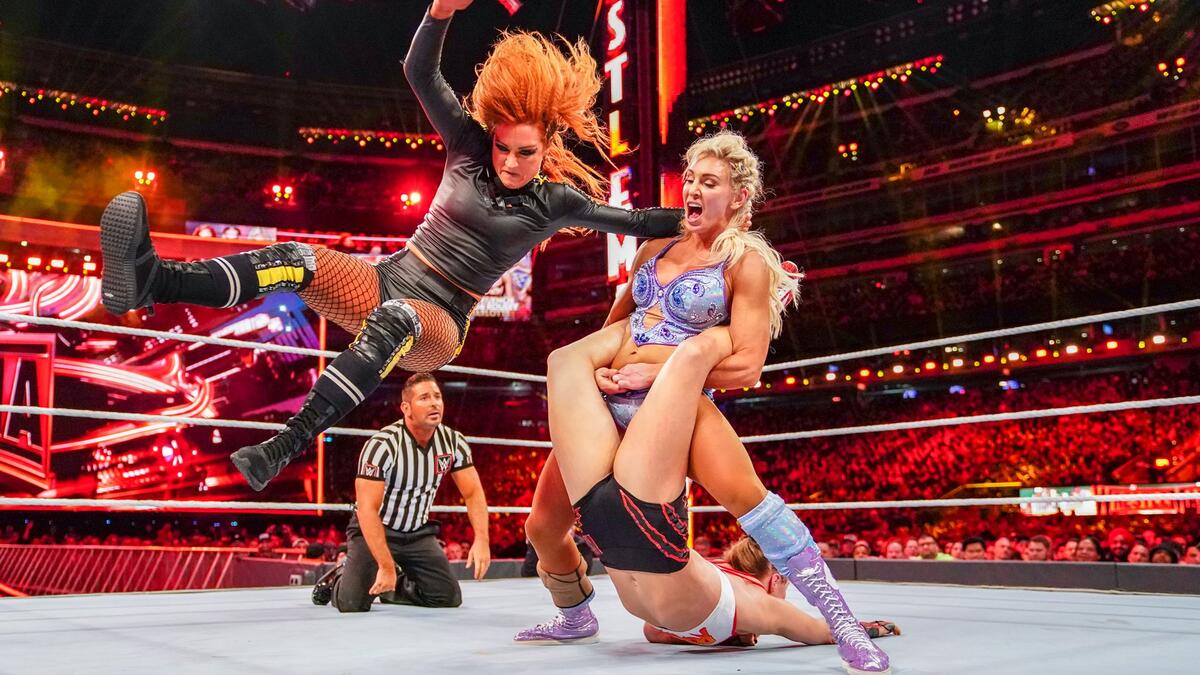
Vince McMahon is certainly not worthy of any praise for his creative booking in the last 20 years, and even less so for his actions as a person. However, in comparison to Triple H, it could be argued that he more frequently softened on his own prerogatives to go where he thought the money was. The first-ever women’s Wrestlemania main event between Becky Lynch, Rhonda Rousey and Charlotte Flair in 2019 is perhaps the best example of this.
Ronda Rousey’s foray into wrestling undoubtedly teased the possibility that the women could genuinely main event Wrestlemania one day. Her groundbreaking achievements in UFC, which in turn led to unprescented mainstream popularity beyond the sport, brought considerable attention to the product and womens wrestling overall. With this foundation set, it seemed inevitable that, perhaps with that right story and talent, the women could one day take centre stage at Wrestlemania. This possibility of this seemed to inch forward ever so slightly once The Man arrived. Becky Lynch’s rise in popularity in 2018 ascended beyond the women’s division – for perhaps the first time in wrestling history, a woman was the biggest star in the whole company.
The rivalry between Lynch and Rousey seemed to hit the goated wrestling rivalry sweet spot of a fan-backed favorite against the company’s darling. By the end of 2018, fan’s were eager to see Ronda’s automatic place at the top, in spite of her sub-par in-ring skills and lackluster mic skills, be challenged. Becky, finding herself at the right place and right time, was the perfect one to do it. While the two were meant to face each other at Survivor Series 2018, the nixing of this match became a blessing in disguise. Nia Jax’s famous punch allowed Becky’s popularity with fans to skyrocket to an unprecedented level, while Ronda’s moved increasingly in the opposite direction. The interest in seeing the company’s two biggest stars finally face off, and especially in seeing Becky take Ronda down, was palpable. And while Charlotte’s unnecessary involvement and WWE’s overbooking of the story in the weeks prior to Wrestlemania slightly dampened fans’ anticipation, it still seemed unquestionable that the women should main event that year’s Wrestlemania.
Aside from the story and its participants, timing also played a big part. By the mid 2010s, the western world was seeing a rise in popularity of women’s sport and female athletes, as well as an increased social consciousness towards DEI and fourth wave feminism. The WWE, always eager to capitalise on the cultural zeitgeist and rewrite their own historical narrative, subsequently shifted a greater focus towards its womens division, to the point where the women could even be considered “top stars.” This isn’t to discredit the women’s hard work that got them to this point, particularly in considering all the opportunities they had already knocked out of the park. Rather, it’s to say that timing can play a considerable role in propelling this hard work to the main event spot. Trish Stratus and Lita have both stated that while the main reason for the first-ever RAW main event was their deeply personal feud and the long-build of their story, it also helped that this was the go-home show for Survivor Series. It meant that WWE were likely saving any potential main-event clashes between their male superstars for the PPV, thus opening the door for the women’s story to take centre stage that night1.
If we think about Triple H’s historical booking and view of womens wrestling in comparison, it’s a bit of an interesting case. He played a crucial role in helping female wrestlers showcase their talent to fans during NXT’s rise in the mid-2010s. Simply giving the women equal time in their matches to the men undeniably helped reshape public perception of what the women were capable of. However, if we take a closer look into NXT at the time, its context also plays an important part. NXT was seen as being an “alternative” to the main roster at the time, with the brand actively marketing itself as such. Triple H was slowly bringing in popular indie names from other companies like NJPW (previously unheard of under McMahon’s rule), and a grittier, more wrestling-focused product compared to the carny, Hollywoodized approach McMahon had towards the main roster. As such, having its women division actually stand out helped act as a differentiator to the main roster, where the women were still having 2-minute matches with no storyline. NXT’s womens division during this time was perhaps akin to the popularity of TNA’s knockouts division in the late 2000s/early 2010s, which in turn helped shape the product as the rough-around-the-edges, cooler alternative.
However, while we can give Triple H his props for rightfully allowing Sasha Banks and Bayley main event NXT Takeover: Respect, the first time that two women had ever main evented a WWE special event, it’s often forgotten that the two women’s previous match at NXT Takeover: Brooklyn went on as the second-to-last match. The main discourse coming out of this event wasn’t only that their match was easily the best on the card, and potentially the greatest women’s match of all time. While their match was billed as the co-main event, there was confusion as to why the women weren’t given the actual main event, based on their build, history, in-ring chemistry and rising popularity. And while they did main event the following Takeover, this was in front of the significantly smaller Full Sail University crowd.
—————————
1 DS Shin, “Trish Stratus and Lita on Historic RAW Main Event, Unfinished Business, and WrestleMania Rumor,” posted December 13 2024, YouTube video, 2:50 to 3:05, Ring the Belle
—————————
Both matches played a crucial role in bringing the womens revolution to a head. However, the undeniability argument still stands. Had the women not outperformed every mens match on that Takeover: Brooklyn card not only by a little, but to the point where discourse on Triple H’s failure to put them in the main event was predominant, would they have even been considered for the main event of Takover: Respect? If the match had been great, but not excellent (perhaps like Samoa Joe vs Finn Balor, which was the main event that night in Brooklyn), would they have even been considered a co-main event again?
In her essay written for The Players’ Tribune`, Charlotte Flair addressed the incredible amount of pressure placed on the women to constantly perform above expectations, or risk never getting the opportunity again. While discussing on her match with Becky and Sasha at Wrestlemania 32 for the newly created Women’s Championship, she states:
“I feel like this weird thing happens when you look back on history, where in retrospect stuff feels inevitable — when it actually really f***ing wasn’t. And that’s kind of what I think happens now with 32, and the way people remember our match. It’s part of WWE history. It’s so iconic. So it’s like, OF COURSE we killed it. OF COURSE we stole the show, and outwrestled every man on that card. OF COURSE it was the first of many women’s classics at WrestleMania.
Except……. NOT of course?????
No, for real: We could have just sucked!!! I really do wonder that sometimes: What if we’d had a bad match that night? Who knows when — who knows IF! — the women would have been given another shot. Like, maybe everything would be different now. And it’s so funny, because if I told you “we knew” how high the stakes were in that moment, obviously I’d be lying.”2
The implications of Charlotte’s statement are pretty astounding when you think about it, because she’s right. History does read like a prewritten series of events, where the women were destined to rise up the ranks of WWE until finally reaching the main event of Wrestlemania in 2019. And yet, they weren’t. Because despite the women’s stellar performances in the two years prior to this match, the expectations of this match and its implications for womens wrestling were astronomically high. This was the first time, perhaps since Mickie James vs Trish Stratus at Wrestlemania 22, that the women were being prominently featured at a Wrestlemania. The Women’s Revolution had started less than a year prior, and this Wrestlemania truly felt like the litmus test as to whether or not it had succeeded in the eyes of the WWE. All three women were pretty much carrying a decade-worth of calls for female wrestlers to receive better treatment, and this was the pièce de résistance. Either they delivered, or they went back to being grateful for two-minutes of TV time.
—————————
2 Ashley Fliehr, “How Am I Going to Be Charlotte Flair Today?,” The Players’ Tribune, July 8 2025, accessed June 17 2026, The Players Tribune
—————————
Thankfully, the match was excellent, and was lauded by most as the best match on the card. However, Charlotte’s question still remains. What if the match had sucked? At this point, the stakes for the main roster’s women’s division were as low as getting a half-decent story and a match time over 10-minutes, let alone the main event of RAW and Smackdown. The idea of main eventing PPVs and a Wrestlemania felt hundreds of years away.
What if the match had sucked?
This question perhaps poses the greatest parallel between Triple H’s booking of the women’s division and the men’s division. The main event of that year’s Wrestlemania was (ironically) Triple H vs Roman Reigns, which received pretty negative reviews at the time. And yet, it wouldn’t have even been a question as to whether they’d continue to be booked as main event stars, or receive another main event spot in the future. Even in this current era, when the women have proven themselves time-and-time again as ratings draws and merch sellers, and their matches as deserving of main event spots, the gap in expectations and treatment between them and the men is still highly skewed. So why is that? It’s simply because Triple H can’t see female wrestlers as being stars on the same level as male stars.
If we consider Triple H’s “colourblind” thinking in regards to not seeing a difference between the male and female wrestlers, it all seems to come down to an inherent belief that stardom is underpinned by androcentricsm; that the quantifiable ‘talent’ of his wrestlers should be measured by the same set of male-centric principles, rather than their differences highlighted as strengths. As around 60% of WWE’s fanbase are male, and 57.8% of the fanbase are caucasian, there’s perhaps an underlying assumption that a larger portion of the product and its talent need to cater towards these demographics by reflecting their own identities on screen. Aside from the few lucky ones that are able to bypass their creative stifling and get undeniably over, the men’s division, women’s division, and tag divisions’ talent are therefore weighed up by their adherence to a predominantly white, masculine, tough-guy persona, one that rarely shows emotions and has huge muscles (quite literally Triple H himself).
Ronda Rousey has famously stated her annoyance at the women’s title still having the word ‘women’ announced prior to it. And while her argument ideologically is in support of the women’s title being treated as equal to men’s, I question whether that’s truly a helpful comparison. In fact, this argument seems to construe the word “women” as inherently negative, rather than simply identifying them as different to the men’s division. This in turn tends to demonize femininity, which is more likely to be associated with women, as not having a place within wrestling and sports as a whole. For many fans, femininity in wrestling is reminiscent of a time where ‘women’s wrestling’ was considered Bra and Panties matches and jealousy-fueled catfights with misogynistic undertones. Even recently, Candice Michelle’s opinion that the current womens wrestling landscape perhaps misses some of the femininity that made previous eras more engaging was met with criticism, as if the desire for femininity in wrestling correlates with a desire to return to bikini contests and lingerie pillow fights.
However, femininity does have a place in wrestling, and if WWE had the ability to be even a little open minded, femininity doesn’t need to overlap with the Bra and Panties era of oversexualising its female wrestlers. Imagine if WWE had tried to do a story like Trish and Mickie for the men? It probably wouldn’t have worked. The fact that they were women – that Trish represented both the top female wrestler and pinnacle of WWE’s diva branding, the type of person that Mickie would be an obsessive, overexcited superfan for, all while blurring the lines between the extent of their relationship – made the angle uniquely brilliant. The same goes for Trish and Lita’s storyline with Chris Jericho and Christian, where each’s failed relationship could develop into a full blown battle-of-the-sexes dynamic. This could only be done because they were women, not in spite of it. Fans of the Divas era lament the days of Halloween Battle Royals, Dress-Up competitions and holiday-themed photoshoots – not because they deviated from “serious” championship feuds, but because they provided lighthearted, campy entertainment concurrent to them.
Nowadays, it seems impossible for WWE to consider that their female wrestlers can embrace their femininity and be powerhouse performances at the same time, even when TNA’s Knockouts Division were successfully doing both more than fifteen years prior. In fact, WWE’s own womens division was doing it in the 2000s. Lita was hurricarana-ing boys across the ring and throwing them off ladders, all while wearing a throng, whipping her hair around and ripping off her shirt. It never felt like she was doing this to appeal to a straight male audience, but simply because she felt like doing it. Trish would go from leading a Diva Dogeball team to having a banger championship defense at the following PPV. Both realities were possible, and both could thrive simultaneously.
A great lack in WWE’s storyline in this current era is its inability to accentuate the strengths and positive differences between its male and female performers. Even when WWE tried to tap into stories centered around intergender relationships and feuds, they tend to limit themselves to it being one or other. Rhea Ripley and Liv Morgan’s fued had the potential to be built with nuance on the latter’s years-long resentment and lust for revenge, with the final act of her taking Rhea’s boyfriend being the cherry on top. Sadly, it’s only the latter point that was highlighted, and feud eventually became diluted to the point of revolving around a male-centric jealousy.
There’s always going to be a place for Triple H’s wheelhouse of androcentric storytelling, like the “I want to be the best”, “I want to be champion”, and “you betrayed me and I want revenge” stories we see on TV every week. But when all of his stories amount to these three prerogatives, and without any of the nuances or differences in male and female characters being highlighted that allow fans to invest in them, they all tend to blur into the same thing. Even more so, if the women can’t measure up to the male-centric features that constitute these androcentric stories, and therefore aren’t able to be seen in the same way as the top male stars that predominantly feature in these stories, how can they ever be expected to reach the top?