
Part 2: Will the Women Main Event Wrestlemania Again?
Guest Feature Article by Kiran Patel
Let’s consider the last few years, and how Triple H’s treatment of the top female storylines leading into Wrestlemania have paled in comparison to the mens. Perhaps the best example of this was Bayley and Iyo Sky’s feud in the lead up to Wrestlemania 40. At Summerslam in 2022, Bayley would return from injury after a year of being out of action, alongside Iyo Sky and Dakota Kai. Together, the three would form a group called Damage CTRL, and go on to team together for close to three years, later adding Asuka and Kairi Sane to the group. Over the course of 2023, cracks in the group would begin to grow, particularly between Iyo and Bayley. Iyo’s rise to the top of the women’s division, as well as her close relationship to Asuka and Kairi, started to interfere with Bayley’s self-positioning as the group’s founder and leader. This would all come to a head following Bayley’s 2024 Royal Rumble win and discovery of Iyo & the Kabuki Warriors’ plans to turn on her. Bayley would finally retaliate against them and declare herself as Iyo’s Wrestlemania opponent.
On paper, this feud had all the workings of not only being an all-time classic feud, but the rightful contender for the Wrestlemania main event. Bayley, a once beloved babyface in NXT, already had the fans rooting for a renewed period of success, and the reaction she received upon winning the Royal Rumble only cemented the potential of an upcoming babyface run. Her emotional devestation at wanting the group as a whole to succeed and still being betrayed found a resonance with fans that could clearly see her natural leadership and selflessness beyond the ring. Iyo’s own dilemma in siding with the women who she’d grown up in wrestling with, or remaining loyal to the woman that brought her to the main roster (and aided a large part of success) added another rich layer. There was also the wildcard of Dakota Kai, who had been out with an injury and was largely seen as the mediator between the two – where would her loyalties lie? Had WWE not already announced the winner of each Royal Rumble would main event Wrestlemania, it felt impossible to find another feud or match that could measure up to the proverbial heights that Iyo vs Bayley were set to achieve.
And then, The Rock happened.
The confusion around Pat McAfee’s last minute addition to this year’s main event storyline can perhaps only be trumped by The Rock’s addition to Wrestlemania 40 two years earlier. On the very same show that Bayley declared herself as Iyo’s Wrestlemania opponent to huge fanfare, that year’s men’s Royal Rumble winner and biggest babyface on the roster, Cody Rhodes, would announce that he was giving up his spot in the Wrestlemania Night 2 main event for The Rock. Despite no previous storyline or prior indication that this is where things were headed, an entire years-worth of booking was traded in an instance for a long-awaited “dream match” between The Rock and Roman Reigns. However, fans would quickly make it clear that the trade was not worth it. After receiving “go away” heat for perhaps the first time since 1998 at the Wrestlemania 40 Press Conference and hearing fans’ demand that they wanted Cody back in the match, The Rock’s ego went into overdrive. And while perhaps this thankfully didn’t mean insisting on taking Rhodes’ main event spot, it did mean forcing his way into a different main event spot.
In the weeks that would follow, Smackdown’s TV time would increasingly be eaten up by The Rock to justify his inclusion at Wrestlemania. Between February 9th 2024 (the Smackdown after the press conference) and April 5th 2024 (the Smackdown before Wrestlemania), The Rock would roughly average around 25 minutes of TV time per appearance and a total of 4 hours TV time within 10 appearances. A number of these segments ran longer than 30 minutes, with reports suggesting that the March 1st show and March 15th show had to be significantly reshaped due to The Rock going over his allotted time and cutting into other performers’ segments3. In comparison, the Damage CTRL story would average around 6-7 minutes per appearance, with a total of 60 minutes of TV time, despite having an additional two weeks of TV time prior to The Rock’s arrival. This means that The Rock had around four times more TV time than Bayley and Iyo Sky. Only two of his segments could match the total two-month build that the women received. As time went on, interest in Bayley and Iyo Sky’s story significantly diminished in the face of The Rock’s suffocating presence on the blue brand.
Given the amount of time being invested into The Rock’s feud with Cody, it was perhaps unsurprising that many fans would be singing his praises. His usual shtick now had a new twist for the first time in decades, and his commitment to pivoting and creating an engaging storyline between himself and Rhodes, as well as making Rhodes into an even bigger babyface, was retrospectively seen as a highlight of that year’s Wrestlemania build. It also helped that the tag match was given 44-minutes in the Night 1 main event (the second longest in Wrestlemania history), and included the usual cinematic-bullshit-Bloodline-shenangins that created a spectacle beyond the in-ring action itself.
What’s often ignored in this retrospective, however, is that only a few weeks prior to his return to WWE, The Rock was appointed to the Board of Directions of TKO, the company that WWE sits under. Once committing to being the monster-heel in his story against Cody Rhodes, The Rock even played into his new role at the top of the corporate food chain, creating (or perhaps stealing) the gimmick of ‘The Final Boss’ that was well-received by fans. But while this gimmick acknowledged and played into his actions onscreen, it didn’t fully acknowledge his power behind-the-scenes. Despite being a PG show, The Rock would continually swear and make explicit comments towards Rhodes and the audience as a way of generating shock-factor reactions – a luxury not granted to his fellow full-time wrestlers. As discussed, he could also frequently go over his allocated TV time and take an ample amount of time to build the desired narrative with the crowd, as well as create long social media promos to expand on this without creative limitations. In essence, The Rock manipulated his position not only as a popular wrestler, but as a corporate head, to have full creative freedom over his story without repercussions.
—————————
3 Andrew Kelly, “The Rock’s WWE Smackdown Segment Overran, Time Cut On Matches Again,” Cultaholic, March 17 2024, accessed on June 17 2026, Cultaholic
—————————
And sure, the star-power, charisma and nostalgic-value of someone like The Rock will always make him a draw to wrestling. But Triple H’s meritocracy-based myth that the best story will main event Wrestlemania was clearly exposed during this time period. Rather than the means justifying the end, it was the end that justified the means.
There was no way that an ego-bruised Rock would tuck his tail between his legs and gracefully bow out of a show that no one really wanted him at. He would get his main event match one way or another, and it would come at the cost of Bayley and Iyo’s earned spot in the main event of Night 1. Both he and the WWE not only used their creative power to position his match as the only possibile main event of Night 1, but purposefully sabotaged the build of the story that was planned to be the main event of Night 1. Beyond The Rock’s ego, it is perhaps easy to see why WWE backed this approach as well. A trusted, mainstream star will always be easier to rely on to draw fans rather than investing in two lesser-known women for that spot. And yet, if the former requires over 4 hours of TV time within a 7-week period and profanity-laced segments to tell an intriguing story, does it really deserve the main event spot that it claims to have earned?
Nonetheless, it is here that the women find themselves in a cache-22 situation. While washed-up male wrestlers can either emerge from the woodworks of irrelevancy to be in the main event, or the current male stars try to out-politic each other for the spot, it is only the women that continue to be judged and upheld to WWE’s standard of a so-called meritocracy. If both Bayley and Iyo’s story was clearly not the best in the lead up to Wreslemania, despite the internal sabotage, male egos at play and, oh yeah, telling us that it would be the main event, then why should they get to main event?
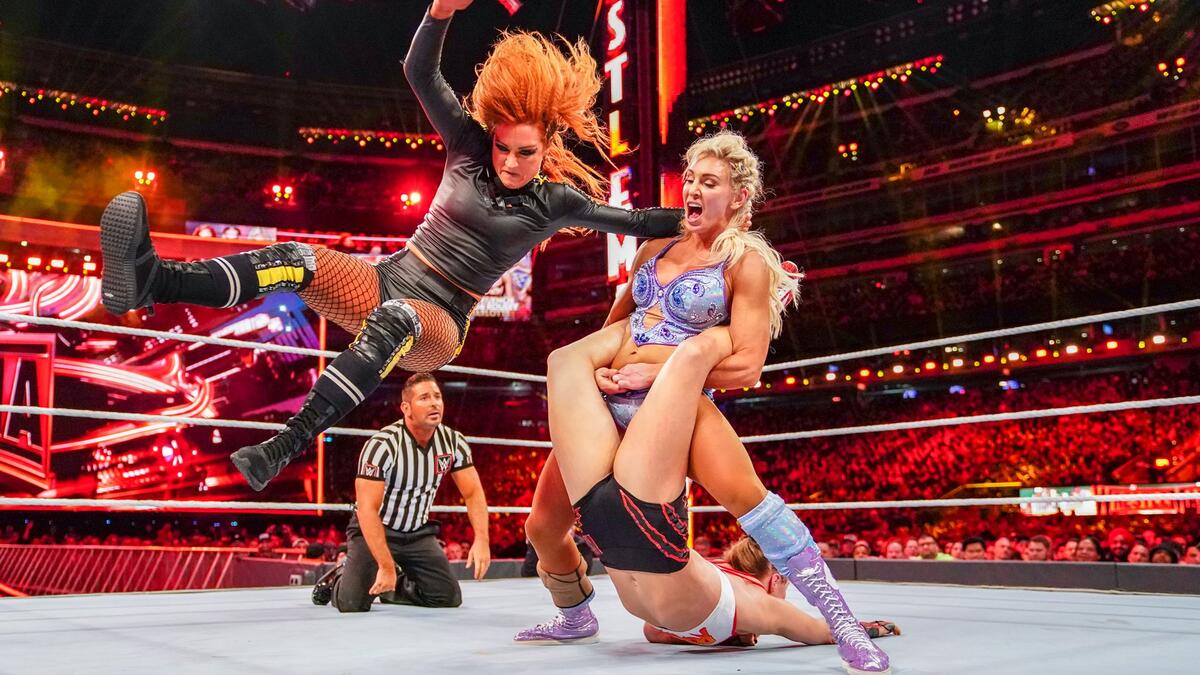
The same goes for Rhea and Charlotte in 2023, where the former’s win at the Royal Rumble would lead to a highly-anticipated rematch between the two following their acclaimed match at Wrestlemania 36. Despite the deep history between the two, their stellar matches together, and Rhea’s skyrocketing popularity during this time, WWE made the strange decision to turn this into the story of an established star (Charlotte) and an up-and-coming rookie (Rhea) wanting to be made a star, which really made no sense at all. The two had already faced multiple times, with Rhea already being a multi-time champion across WWE. A feud that had the potential to be nuanced and layered became completely diluted of its flavour.
The same can also be said for Rhea vs Iyo vs Bianca in the lead up to Wrestlemania 41. What was expected to be a long-time dream match between Rhea and Bianca suddenly turned into a triple threat when Iyo beat Rhea for the Womens Championship only a few weeks prior to Wrestlemania. It appeared as though Rhea was set for character development that would see her cockiness and inability to trust people turn into her downfall. Bianca was also going through an interesting character development, given that she won the Elimination Chamber on the same night that her former tag team partner demolished her current tag partner and best friend. Not to mention, all three women had a storied history since their time in NXT. With all these different ingredients fusing together, the potential felt enormous.
And yet, once again, WWE would refuse to give the match the prominence it deserved. The build consisted of short, repetitive segments, where Rhea would whine her way into the match despite being a babyface, and any signs of character development were dropped in favour of her Mami shtick. Iyo would be consistently counted out despite being the champion, and Bianca was left getting booed every week despite rightfully being in the match. To add salt to the wound, the match that would end up main eventing Night 1 of Wrestlemania 41 wasn’t even a championship match, nor did it hold the intrigue of the women’s match beyond the performers themselves.
However, despite the bad booking for all three of these storylines, and the collective perception that all three deserved the main event spot, there’s another element that unites them. All three matches delivered exponentially. It could even be argued that these are among the top 3 womens matches in Wrestlemania history, and certainly considered among the best matches at each year’s event. Rhea vs Iyo vs Bianca would even be the first womens match to receive 5 stars from Dave Meltzer (and that’s even taking Meltzer’s women tax into account, so it could probably be considered a 6 star match).
If we’re using Triple H’s meritocracy-based framework to assess whether the women should main event, then Rhea and Charlotte stealing the show had clearly set the groundwork for the women to main event the following year, right? But okay, The Rock getting booed meant a need to overhaul creative plans and ensure that his fragile ego wouldn’t be permanetetly damaged – let’s give it to the women next year. Surely, three of the most talented and popular women in the current era, with a storied history and proven capability to deliver, more than warrants being in the main event – especially now that Roman’s reign of terror had finally ended. Ah, but wait! He’s Roman Reigns! He’s main evented nine times; how could he possibly manage being anywhere else on the card? And Punk has never main evented before – it’s a historic moment! And what about his and Seth’s tiresome, year-long rivalry that was supposed to have culminated in January? And The Shield! Don’t forget about The Shield lore! They can do the chair-shot call-back for the umpteenth time! Yes! How could any other match possibly be the main event?
There’s a clear case of male fragility in WWE’s creative team, and most importantly in Triple H. The idea that female wrestlers, once intended to serve as eye-candy and satisfy a small quota of the audience-base, could potentially outshine their prized male wrestlers is too risky to be given credence. And not only that, but women who consistently deliver in-spite of being actively sabotaged by their own management. Imagine what we could’ve witnessed had the company actually backed their stories?
But rather than own up to the criticism and do the right thing, WWE has instead found a loophole. For years they’ve gotten away with erroneously promising that the women’s Royal Rumble winner will main event, but diluting their story just enough to make it appear unworthy of the spot. This year, however, fans en masse seemed to catch on to WWE’s sly strategy, and demanded that the Womens World Championship match take the spot that had been consistently promised. And if history had proven anything, the women’s ability to deliver on the grand stage would only amplify calls for them to main event next year’s Wrestlemania. So if WWE can’t silence them by sabotaging the women’s build-up, how exactly do they deal with that pesky issue of the women’s matches outshining the men’s?
If the resounding criticism of this year’s Wrestlemania was the number of ads and Hulk Hogan documentary clips, the short match times were a close second. The majority of matches on both nights clocked in at the 10 minute mark or lower. The only exceptions to this, however, are the two men’s world title matches. Cody Rhodes vs Randy Orton clocked in at 22 minutes and 44 seconds, while Roman Reigns vs CM Punk clocked in at 33 minutes and 55 seconds, not including entrances and Reign’s long-ass walk to the ring. In comparison, Rhea Ripley vs Jade Cargle clocked in at 10 minutes and 8 seconds, while Liv Morgan vs Stephanie Vaquer clocked in at a mesley 6 minutes and 51 seconds. This means that the combined women’s world championship match times amounted to less than a third of the combined men’s world championship match times, as well as each match receiving the death-slot on their respective night of Wrestlemania. That’s hardly enough time to tell a half-decent story, let alone for a world championship match.
And yet, WWE’s plan worked to perfection. While fans were initially disappointed by the short match times, any backlash was quickly overshadowed by the acclaim awarded to Reigns vs Punk. Thus, WWE’s teleological meritocracy narrative would now be in full swing. The men had seemingly “proven themselves” as worthy of the main event, which was WWE’s prerogative all along, while both women’s matches were forgettable at best. This time, while no fault of their own, the women will be showing up empty-handed in the rigged bid for next year’s Wrestlemania main event.